Tow Hitch & Lifting Jib for Skid Steer, Track, Wheel Loader & Hydrostatic
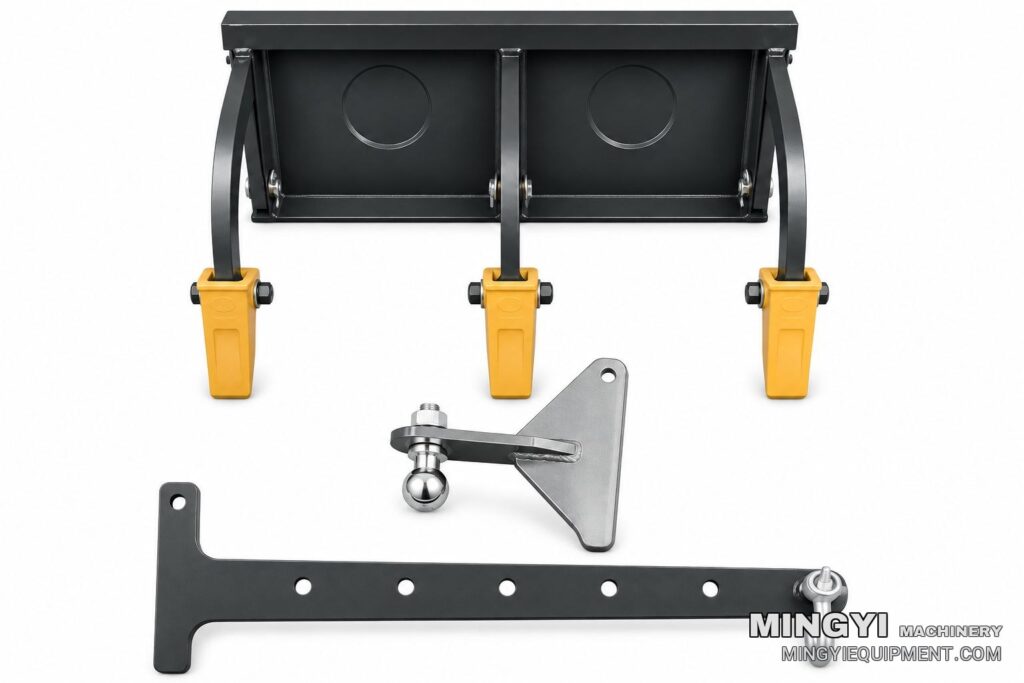
This page covers two attachments that share one mounting frame, because they answer the same question: what does the loader do when it is not digging or loading. The tow hitch — a receiver or a trailer ball on a plate that locks into the quick attach — turns a skid steer loader, compact track loader, wheel loader or hydrostatic wheel loader into a yard tractor for trailers, spreaders, sweepers and bowsers. The lifting jib — a crane jib that pins to the same frame — uses the loader’s own lift circuit to raise engines, stone, precast rings and timber where a telehandler will not fit. They are sold together because most buyers need both, and they are described separately below because towing and lifting carry different limits.
How it works
The towing side is mechanical: the frame locks into the quick-attach plate and presents a receiver box or a ball coupling at a height that suits the drawbar of the trailer you run. No hydraulic service is needed; the loader simply becomes a very short, very tight-turning tractor, which is why it shunts trailers in yards where a pickup cannot reverse. The jib pins into the same frame and carries a hook at the nose; the loader’s lift and tilt cylinders do the raising, and the jib is fixed-length or telescopic depending on how far the load has to reach. A jib is a lever, not a crane: the further the hook is from the pins, the less the machine will lift.
Lifting within the machine’s limit
The limit is not the jib, it is the carrier. Rated operating capacity and tipping load are quoted at the bucket pins, and a jib puts the load further forward, so the usable figure falls — the machine’s own load chart and the jib geometry decide what can be lifted, and both have to be checked before the first lift. Keep the load close to the machine and the boom low, travel slowly with the load trailed, and use rated slings, shackles and a hook with a latch. Nobody stands or walks under a suspended load, nobody rides on the jib or in a bucket to guide it, and a load is never left hanging while the operator leaves the seat. If you send us the machine model and the weight you intend to lift, we will work through the geometry with you before you order.
Compatibility
The frame bolts or pins to the standard quick-attach plate used on skid steer loaders, compact track loaders and wheel loaders. The MY130S, MY180S and MY180TS hydrostatic loaders take it on a quick-attach plate of the same specification. Neither the hitch nor the plain jib has its own hydraulic service — both work off the loader’s lift and tilt circuits — so there is no auxiliary flow figure to match for the standard versions. Where a hydraulic option is specified, such as a powered winch or a hydraulic jib, it needs the carrier’s auxiliary hydraulic flow to match, confirmed against your machine’s configuration.
Typical specification
The design is fixed: a plate-mounted frame, a receiver or ball coupling sized to the trailers you run, and a jib with a hook, a fixed or telescopic boom and a pin-on or bolt-on connection to the frame. Weight, overall height, jib length and the resulting capacity at the hook vary by carrier and are confirmed against your machine before quoting. Tell us what you tow — trailer type, drawbar height, loaded weight — and what you lift, and the coupling and jib are specified for that combination rather than for an average.
Ordering and shipping
Minimum order one unit, lead time 25–35 days, CE certification and a 12-month warranty. Hitch and jib ship assembled on the plate, with the coupling and hook fitted, and a spare pin and latch set travels in the same container. Photos of the finished unit and a video of it towing and lifting go out before the container is sealed.
Where a tow hitch and lifting jib are used
Twenty-two jobs in two groups: the first half is towing with the hitch, the second is lifting with the jib. Each line names the load, the site and the coupling or sling that suits it.
- Yard trailer shunting — Move trailers, tippers and plant around a yard or between sheds without taking a tractor on the road.
- Fertiliser spreader towing — Pull a trailed spreader to the field and back, hitching at the spreader’s own drawbar height.
- Sweeper and collector towing — Tow a yard sweeper or leaf collector round car parks and forecourts between shifts.
- Water bowser and sprayer — Haul a bowser or a small sprayer to a site where the loader is already working.
- Chipper and log splitter — Take the chipper or splitter to the cordwood instead of bringing the cordwood to the machine.
- Livestock and horse trailers — Shunt an empty livestock or horse trailer in a yard or up to a loading ramp.
- Caravan and camper placement — Spot a caravan or camper on a pitch or in a storage row, using the loader’s tight turning circle.
- Boat and jet ski trailers — Move a boat or jet ski trailer around a yard, slipway apron or storage compound at low speed.
- Tipper and dump trailer hire — Tow a hired tipper to the work area and keep it coupled while it is loaded.
- Winter salt spreader — Carry a salt spreader through a yard, car park or estate road during a frost.
- Compressor and generator — Drag a compressor, generator or lighting tower to the far end of a site.
- Bale and hay trailers — Move bale trailers and hay racks between fields and the yard in season.
- Setting precast rings — Lower a manhole ring, chamber section or cover onto a new excavation with the jib.
- Kerb and lintel placing — Set kerbs, stone lintels and cills on a sling, without a second machine on site.
- Timber beam and purlin lifts — Raise beams, purlins and posts into a frame where a telehandler cannot stand.
- Pump and motor setting — Lower a pump, motor or gearbox onto a baseplate inside a plant room or a pit.
- Attachment handling — Swap buckets, forks and plates on and off a trailer or a rack with the jib and a sling.
- Bagged and bulk bags — Hoist bulk bags of sand, gravel or fertiliser over a wall or into a bin.
- Gate and frame setting — Hold a gate frame or steel post plumb while it is concreted in.
- Stone and block bundles — Lift pallets and bundles of stone or block where forks will not fit underneath.
- Recovering stuck plant — Pull a stuck trailer or small machine out with the hitch and a rated strap.
- Hire fleets and contractors — One hitch and one jib cover the towing and lifting that comes up on a hire fleet or contract.
Both items share the quick-attach plate with the bucket, so the loader that loads also tows and lifts. Send the carrier model, the trailer weights and the load you intend to lift, and we confirm the coupling, the jib and the capacity at the hook before pricing.
Ask about this machine
Product for this enquiry: Tow Hitch & Lifting Jib for Skid Steer, Track, Wheel Loader & Hydrostatic