Backhoe Digger Attachment for Skid Steer, Track, Wheel Loader & Hydrostatic
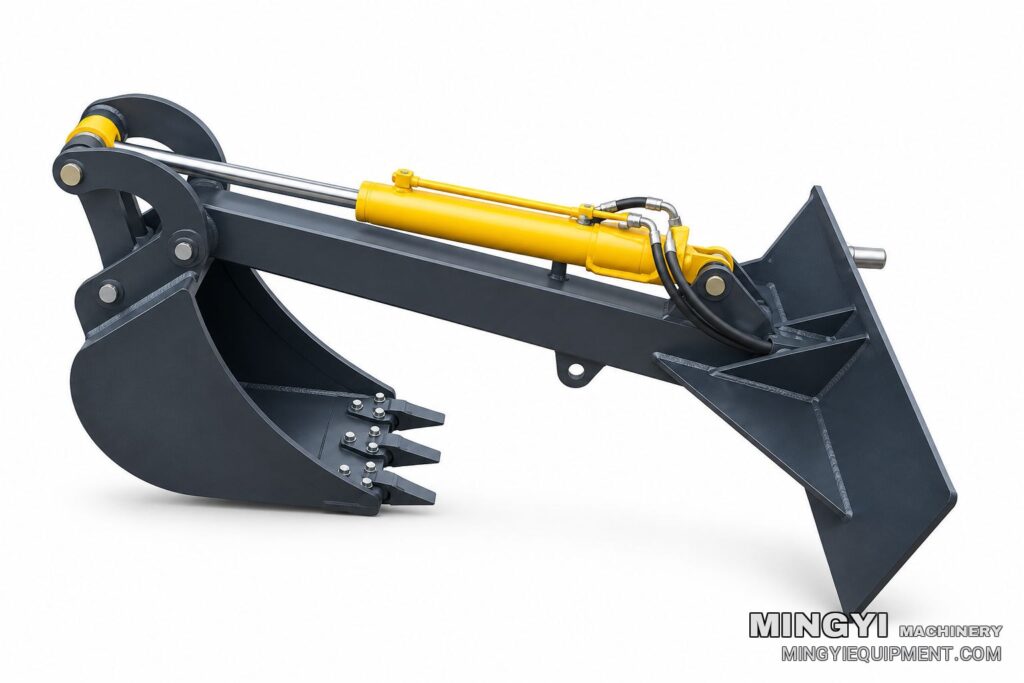
A backhoe attachment turns a skid steer loader, a compact track loader, a wheel loader or a hydrostatic wheel loader into a small excavator. A mounting frame goes on the quick-attach plate, and from it hang the main boom, the dipper and a digging bucket, so the machine cuts and lifts soil instead of pushing it ahead of a bucket. It is a digging arm, not an auger or a post hole digger: the bucket opens a trench, a footing or a ditch bank, and the spoil comes out in a heap the loader can handle.
How it works
The frame carries the boom on a slew pivot, and the swing cylinder takes it through an arc so the bucket can work to one side of the machine or the other; the boom and dipper cylinders give reach and depth. The digging bucket is 200–400 mm wide for trench work, and other widths are supplied for footings and pond edges. On the side-shift version the whole boom assembly slides along the frame, so the machine stands parallel to a wall, a fence or a kerb and the bucket still cuts a straight line hard against it. Stabiliser legs, where they are fitted, take the weight off the axles while digging. The operator stays in the seat and works the loader’s own controls through a valve block plumbed into the auxiliary circuit.
Where it digs
Water, gas and cable trenches, land drainage, ditch and swale cleaning, strip footings and pier bases, tree pits, pond edges, culvert and headwall work, yard crossings for drainage pipe. The list below runs from the jobs the arm is bought for to the occasional ones, and each line names the ground or the site it suits.
Compatibility
The frame bolts to the standard quick-attach plate used on skid steer loaders and wheel loaders, and the compact track loader carries the same plate. The MY130S, MY180S and MY180TS hydrostatic loaders take it on a quick-attach plate of the same specification. Two things decide whether it works on a given machine: the plate, and the auxiliary hydraulic flow. Digging is a constant-flow job, and boom, dipper and swing all draw on the carrier’s auxiliary circuit — it needs the carrier’s auxiliary hydraulic flow to match, confirmed against your machine’s configuration rather than assumed from the model name.
Typical specification
What is fixed is the design: a pin-on frame for the quick-attach plate, a boom and dipper sized to the carrier, a 200–400 mm digging bucket as standard, and a side-shift option. What varies by carrier is reach, digging depth, weight and the hose and coupler set, all matched to the machine before quoting. Tell us the loader, the trench width and the ground — clay, gravel or made-up ground — and the bucket and frame are specified for it. We do not publish one digging depth for every machine, because the same arm on a narrow loader and on a wide one does not behave the same way.
Ordering and shipping
Minimum order one unit, lead time 25–35 days, CE certification and a 12-month warranty. The frame ships assembled with hoses and flat-face couplers matched to the carrier, and spare bucket teeth travel in the same container. Photos of the finished unit and a video of it trenching go out before the container is sealed.
Where a backhoe attachment is used
Twenty-two jobs, from the trenches the arm is bought for to the occasional ones. Each line names the work, the site and the bucket or option that suits it.
- Water service trenching — Cut a straight trench for a water main or service pipe across a yard, verge or field, at 200–400 mm bucket width.
- Cable and duct runs — Open a trench for power, telecom or ducting, keeping the line straight and the spoil on one side.
- Land drainage repair — Re-open a field drain line that has silted or collapsed, lift the broken pipe and lay the new one in the same cut.
- Ditch and swale cleaning — Reach over the bank and pull silt and vegetation out of a ditch, keeping the profile and the fall.
- Pond and lagoon edges — Work from the bank to lift silt and re-cut the edge of a pond, without taking the machine into the water.
- Strip footings for extensions — Dig footing trenches behind a house or in a rear garden where a mini excavator has no room to track.
- Pier and pad excavation — Open square pads for columns, posts and frames, trimming the sides vertical with the bucket edge.
- Tree and shrub pits — Dig planting pits in a finished garden, working from the path so the lawn is not tracked over.
- Septic tank and soakaway — Excavate the tank hole and the soakaway trench, then backfill with the same machine.
- Culvert and headwall work — Open the channel at a culvert inlet, clear the approach and trim the bank for a new headwall.
- Burst pipe excavation — Open a confined, tidy excavation over a burst main at short notice and keep the walls clean for the repair.
- Irrigation main trenching — Cut a trench for irrigation mains along a field headland, an orchard row or a sports field.
- Sports pitch drainage — Trench the drainage laterals across a pitch or arena, working in strips and reinstating as you go.
- Narrow rear-garden access — Dig where a tail-swing excavator cannot pass a gate or an alley, using the loader’s own footprint.
- Bank and batter trimming — Dress a ditch bank or embankment back to a clean batter, cutting with the bucket rather than the blade.
- Gate posts in stony ground — Dig gate and strainer post holes where a bar will not start because of stone and roots.
- Stump and root lifting — Dig round a felled stump, cut the roots and lift it out with the boom.
- Backfilling and spoil handling — Pull the spoil back into the trench and compact it in layers with the same bucket.
- Kerb and gully openings — Open a small excavation for a kerb line, gully or road crossing without breaking out more than needed.
- Yard crossing openings — Cut a crossing through a yard or drive for a drainage pipe, then reinstate the surface.
- Garden pond shaping — Cut the shelf and the profile of a garden pond, trimming the edges by hand from the seat.
- Hire fleets and contractors — One arm on the loader covers the small digs on a hire fleet or a grounds maintenance round.
The backhoe shares the quick-attach plate with the bucket, so the loader that digs the trench also backfills it. Send the carrier model, the trench width and the ground, and we confirm the frame, the bucket and the hose set before pricing.
Ask about this machine
Product for this enquiry: Backhoe Digger Attachment for Skid Steer, Track, Wheel Loader & Hydrostatic