Stump Grinder for Skid Steer Loader, Compact Track Loader and Hydrostatic Wheel Loader
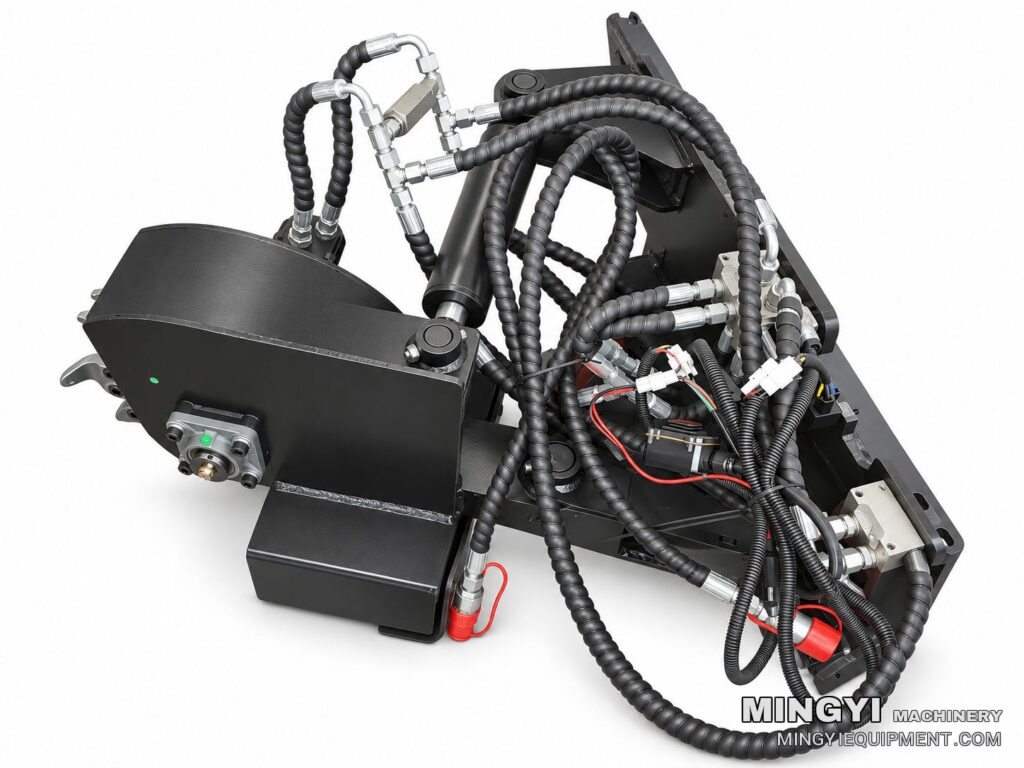
A stump grinder is a hydraulic cutting wheel with replaceable carbide teeth, carried on the quick-attach plate and driven from the loader’s auxiliary circuit. The wheel is swept across the stump face and stepped down until the wood sits below the surface, so the stump is ground into chips rather than dug out and carted away. It goes on a skid steer loader, compact track loader, wheel loader or hydrostatic wheel loader, and it finishes the job the felling started: the ground is clear, the hole is small and the spoil is a pile of chips.
How it works
The teeth run around the rim of the wheel. The head is fed into the stump and swept sideways, each pass taking a slice off the top, then the head drops a step and sweeps back. Nothing is cut cleanly: the carbide tips chip the wood down into chips and dust, which a deflector throws down into a pile instead of across the site. There are two layouts. On a fixed head the operator tracks the loader across the stump to cover its width. On the swing (side-shift) head the cutting wheel pivots on a hydraulic cylinder and sweeps while the loader stands still — that is the version for a stump against a wall, a fence, a hedge or a kerb, because the machine stays on clean ground and only the head moves. Speed is decided by the wood: green softwood goes quickly, dry hardwood and a butt with stone in it take longer, and light passes keep teeth on the wheel where forcing the head does not. Depth is judged from the surrounding surface, not from the stump: the aim is a shallow dish of chips that rakes out, fills and takes turf or a slab.
Where it works
Gardens and lawns, orchards and vineyards being replanted, boundaries and fence lines, development plots, roadside and utility corridors, dams and embankments, parks and churchyards. The list below runs from the jobs these heads are bought for to the occasional ones.
Compatibility with your loader
The grinder mounts on the standard quick-attach plate shared by skid steer loaders, compact track loaders and wheel loaders, and changes over in the same movement as a bucket. The MY130S, MY180S and MY180TS hydrostatic loaders take it on the same specification of plate. The point that decides whether it works is hydraulic: a stump grinder is one of the most flow-hungry attachments on a loader, and it needs the carrier’s auxiliary hydraulic flow to match — confirm against your machine’s configuration before the head size is fixed. A short-flow machine will turn the wheel, but slowly, and no amount of patience makes up for a wheel that cannot keep its speed in hardwood. The head also hangs well forward, so ballast or a heavier carrier is worth discussing at the same time.
Typical specification
Wheel diameter and tooth count set the size of stump a head will take in a reasonable time, and the tooth type is matched to the wood and to how much grit is in the butt. Swing arc and head offset are typical for the model and vary by carrier; the guard and the chip deflector are part of the working design, not an accessory, because they decide where the spoil goes. Width, weight, flow class and stump capacity are quoted against your machine rather than published as one figure that would be wrong for half the loaders in the field. Spare teeth and the tool for changing them are worth ordering with the unit.
Ordering and shipping
Minimum order one unit, lead time 25–35 days, CE certification and a 12-month warranty. The grinder ships assembled with hoses and flat-face couplers matched to the carrier, and a spare set of teeth can travel in the same container. Photos of the finished unit and a video of it grinding go out before the container is sealed.
Where a stump grinder is used
Twenty-two jobs, from taking out a single stump in a lawn to clearing a felled block. The aim is always the same: get the wood below the surface, keep the hole small and leave chips that rake out rather than a crater to fill.
- Stump removal in a lawn — Grind a garden stump below grade, rake the chips out and bring in soil so the lawn can be re-turfed or seeded.
- Orchard replant — Take out the stumps of old trees in the planting row so the new trees go into clean ground, not into rotting wood.
- Vineyard replant — Grind old vine stumps at the row ends, with the swing head working between the wires and posts.
- Building plot clearance — Clear stumps from a house footprint or a garden area before setting out and digging.
- Fence line and boundary — Remove stumps under an existing fence or along a boundary, working from the clean side with the head offset.
- Roadside and right-of-way — Stumps left after verge or corridor clearance, taken out so the mower and the verge can be maintained.
- Storm-damaged trees — Grind the butts and root plates of blown or split trees, including the part lifted above ground.
- Driveway and path clearance — Take out stumps sitting in the line of a drive, a track or a footpath before the surface goes down.
- Patio and paving preparation — Clear stumps under a patio, slab or parking area so the wood cannot rot and settle the surface later.
- After felling for firewood — Clean up the stumps left through a wood or a hedge line after the timber has been taken.
- Parks and amenity trees — Remove stumps from lawns and play areas in a park, keeping the turf around them intact.
- Golf course and woodland edge — Grind stumps at the tree line and in the rough so the area can be mown and walked.
- Churchyard and cemetery — Take out stumps between graves and headstones, where the swing head works without tracking over the plots.
- Dam, levee and embankment — Remove stumps and root plates from a bank so roots cannot rot out and leave a seepage path.
- Shelterbelt renewal — Grind the stumps of an old windbreak row before replanting the belt.
- Smallholding tidy-up — Clear stumps from gateways, paddock corners and yards where they catch machinery and stock.
- Stumps tight to a wall — Grind a stump hard against a building or a wall, with the swing head reaching where the machine cannot stand.
- Beside kerbs and tarmac — Take out a stump next to a kerb, a drive edge or fresh tarmac without running the loader over the surface.
- Surface roots in turf — Shave the roots that stand proud in a lawn or a paddock so the surface can be mown and rolled.
- Track and trail clearance — Clear stumps out of the line of a farm track, bridleway or forest trail.
- Wet-ground willow and alder — Grind softwood stumps on wet ground from a tracked carrier, where a wheeled machine would cut up.
- Rental and contracting fleets — One grinder keeps stump work on a hire fleet or a contracting round without a dedicated machine.
The grinder shares the quick-attach plate with the bucket, so the loader that clears the site also clears the stumps. Send the carrier model, the stump diameter and the wood, and we confirm head size, swing or fixed and flow class before pricing — a head sized for a wheel loader will stall on a low-flow compact track loader.
Ask about this machine
Product for this enquiry: Stump Grinder for Skid Steer Loader, Compact Track Loader and Hydrostatic Wheel Loader