Rock Bucket for Skid Steer Loader, Compact Track Loader and Hydrostatic Wheel Loader
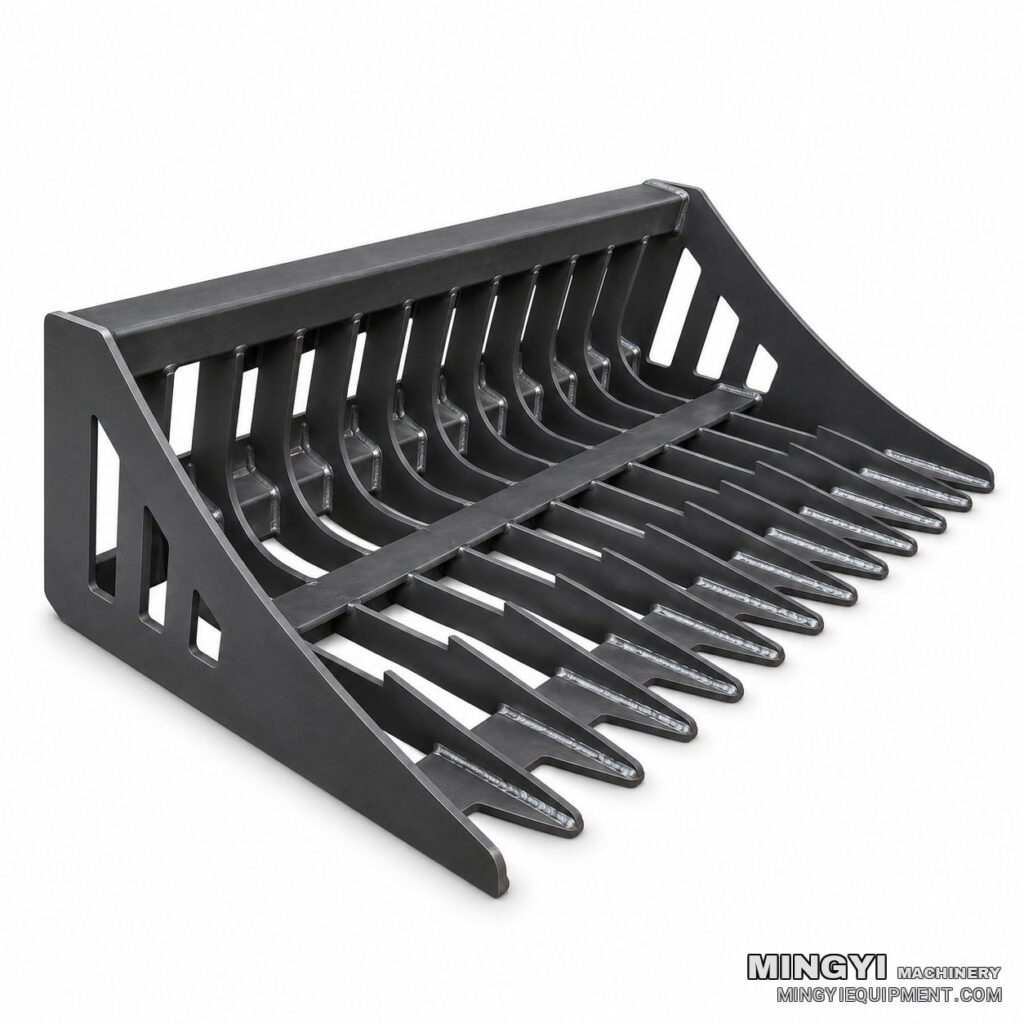
A rock bucket, often sold as a skeleton bucket, is a bucket with the floor taken out and replaced by heavy tines: a plate body, a reinforced edge or tooth bar at the front, and a set of rods set apart so that soil, sand and small stone drop through while rock, root and rubble stay in the basket. It hangs on the quick-attach plate of a skid steer loader, compact track loader, wheel loader or hydrostatic wheel loader, and it changes the loader’s job from carrying to sorting: the machine that moves the heap can also sift it.
How it works
Fill it, lift, curl back and shake. The fine material falls between the tines, the coarse stays on top, and the operator works through a heap instead of scooping the whole lot and tipping it somewhere else. Raking is the other half of the job: the front edge is dragged along the surface to gather stone off a field or a track without taking a bucketful of soil with it. Because the floor is open, water and slurry run out as the load is lifted, so a wet load arrives lighter and cleaner than it left. Tine spacing decides what the bucket keeps — close spacing holds small stone and root fragments, wide spacing lets rubble and cobbles through — and it is the one choice worth settling before the width.
Where it works
Stone-picking in fields and pastures, root and stump clearance, river gravel, demolition rubble, spoil from excavation, topsoil and yard clean-up. It is a dry-weather tool: wet clay blinds the tines and the bucket turns into a plain scoop, so the best work is done when the spoil will crumble.
Compatibility with your loader
The bucket mounts on the standard quick-attach plate shared by skid steer loaders, compact track loaders and wheel loaders and changes over in the same movement as a digging bucket. The MY130S, MY180S and MY180TS hydrostatic loaders take it on the same specification of plate. This attachment is mechanical: it draws no auxiliary hydraulic flow, so what has to match is the plate, the machine’s rated capacity and the width of the load, because a basket full of wet stone is heavier than the same volume of soil and the loader has to lift it clear of the truck side. Tell us the carrier and the material and both are checked before pricing.
Typical specification
Width follows the carrier, not the other way round: a bucket that covers the wheel tracks grades and rakes cleanly, a narrower one gets between rows and into corners. Tine spacing and tine section are chosen for the job — fine for roots and small stone, coarse for rubble — and the front edge can be a bolt-on tooth bar or a hard-faced cutting edge, both replaceable. Shell thickness, tine count, weight and capacity are typical for the carrier class and are confirmed against your machine; there is no single size that suits a compact track loader and a full wheel loader, and we do not quote as if there were.
Ordering and shipping
Minimum order one unit, lead time 25–35 days, CE certification and a 12-month warranty. The bucket ships assembled with the plate fitted; a spare tooth bar or a set of replacement tines can travel in the same container. Photos of the finished unit and a video of it working go out before the container is sealed.
Where a rock bucket is used
Twenty-two jobs, from stone picking in a field to sorting rubble on a demolition site. The principle never changes: keep the coarse, let the fines out, and shake the load until what is left is worth carrying.
- Field stone picking — Work a ploughed or frost-heaved field and shake the soil out, leaving the stone in the basket for the trailer.
- Rocky pasture clean-up — Clear surface stone from grazing before hay or topping, so the mower and the stock are not working over rock.
- Root and root ball clearing — Lift root balls after felling or clearing, shake the soil off and load the wood out clean.
- Riverbed and gravel bar work — Rake flood gravel off a bar or a riverbank and load the coarse stone without the sand.
- Demolition rubble sorting — Separate brick and concrete from the fines on a strip-out, so the clean rubble can go for crushing.
- Site clearance after excavation — Work through a spoil heap for stone and rubble before the material is carted away.
- Topsoil screening — Take stone and root out of screened topsoil before it is spread on a lawn or a bed.
- Spoil screening for reuse — Sift excavated spoil so the clean stone and the soil can each go back as fill.
- Rock clearing on a building plot — Clear stone from a house plot or a garden area before setting out footings and levels.
- Clean-up after stump grinding — Pick the grindings, root fragments and stone out of a lawn or a drive after a stump has gone.
- Stone for walls and rockery — Sort stone by size as it is picked, so wall stone and rockery stone load separately.
- Loading clean stone — Load stone from a heap and leave the fines behind instead of paying to haul them.
- Driveway and yard stone recovery — Sift contaminated gravel from a drive or yard and spread the clean stone back.
- Flood debris and silt clean-up — Clear stone, debris and silt from a yard, lane or riverbank after high water.
- Scrub clearance follow-up — After mulching or grubbing, rake the roots and stone out of the surface before reseeding.
- Fence line clearing — Clear stone from post positions along a boundary before the driver goes in with the post knocker.
- Beach and jetty clean-up — Gather stone, weed and debris off a slipway or a beach front without taking the sand.
- Rubble for crusher feed — Clean soil out of demolition rubble so the crusher is fed stone, not dirt.
- Trench spoil clean-up — Separate stone from fines at the trench side and backfill with the clean material.
- Paddock renovation — Stone a paddock before reseeding, working the surface until it is clean enough to roll.
- Yard and gateway tidy-up — Lift the stone that has been dragged onto a yard or pushed into a gateway by traffic.
- Landscaping and hire fleets — One bucket keeps stone work, rockeries and clearance jobs on a landscaping or hire fleet moving.
The basket shares the quick-attach plate with the digging bucket, so the loader that clears the stone still loads the trailer. Send the carrier model and the material you are working in, and we confirm width, tine spacing and weight before pricing — a bucket sized for a wheel loader will overload a compact track loader long before it is full.
Ask about this machine
Product for this enquiry: Rock Bucket for Skid Steer Loader, Compact Track Loader and Hydrostatic Wheel Loader