Mixer Bucket — Quick Attach for Skid Steer, Track, Wheel & Hydrostatic Loaders
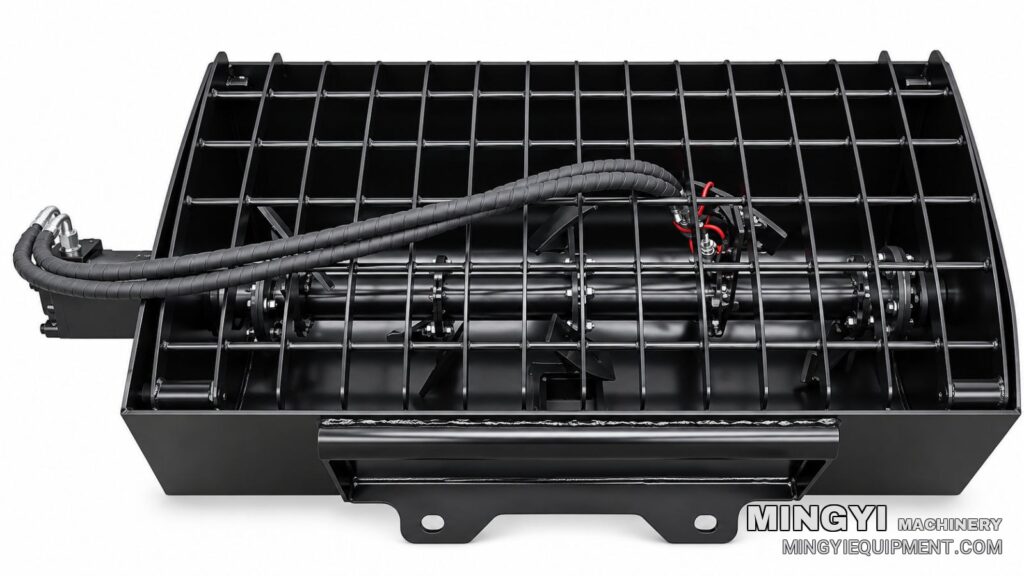
A mixer bucket is a loader bucket with a horizontal paddle shaft turning in the bottom. It hangs on the quick-attach plate of a skid steer loader, compact track loader, wheel loader or hydrostatic wheel loader, loads sand, stone and cement with its own lip, mixes on the way to the pour, and empties by tipping the bucket. It is the tool for site batches: mortar for a day of blockwork, screed for a floor, concrete for footings and small slabs where a wagon cannot get in and a site mixer would leave every barrow as a separate trip.
How it mixes and empties
The shaft runs across the bucket just above the floor, with paddles set in a spiral so the mix is pushed along the bucket, turned over at the ends and brought back. A hydraulic motor at one side drives it through a chain or a gearbox, and the loader’s auxiliary circuit is the power source. Sand, stone and cement go in by bucket lip, bag or shovel, water goes in from a hose or a tank, and the shaft turns while the machine stands or travels slowly. When the mix is ready the operator tilts the plate forward and the batch slides out in a controlled flow; a bolt-on discharge chute or a gate on some buckets puts it exactly where a barrow would have to be pushed. Cleaning is a bucket of water and a few minutes of turning before the cement sets, with the drain plug out.
Mixer bucket or mixer drum
We build both, and they are not the same tool. The concrete mixer drum is a bowl hung on the earth auger drive: it is light, needs no separate bucket, and places a small batch in a ribbon, which suits fence footings and kerb bedding. A mixer bucket is the opposite trade: it still loads, carries and tips like a bucket, so the batch travels with the machine and the volume per mix is larger, but it is heavier, takes more oil and needs the machine’s full lift capacity. If the job is a dozen perfect footings along a fence, read the concrete mixer drum page; if the job is a pallet of blocks, a floor or a base, this is the page.
Fitting it to the carrier
The bucket mounts on the standard quick-attach plate shared by skid steer loaders, compact track loaders and wheel loaders, and the hydrostatic wheel loaders MY130S, MY180S and MY180TS take the same plate in the matching size. The mixing shaft is hydraulically driven, so the carrier’s auxiliary hydraulic flow has to drive it at mixing speed under load, not just turn it empty: a bucket that mixes well on paper can stall in a wet mix on a low-flow machine. It needs the carrier’s auxiliary hydraulic flow to match — confirm against your machine’s configuration, and send the model so the motor, chain ratio and hose set are specified together. A full bucket of wet concrete is heavy, so check the rated operating capacity of the machine before ordering the largest size.
Size and wear parts
Batch volume varies by bucket size and by the density of the mix, so we quote the bucket by its build rather than by a mixing capacity: tell us the batch you want and we match the shell and shaft to it. The wear points are the floor, the end plates, the paddle tips and the bolt-on cutting edge; all are replaceable, and a spare set of paddle tips is worth having in the first order. A bolt-on discharge chute, a water tank bracket and a level or sight line inside the shell are options we fit at build. Bucket width, weight and shaft speed are confirmed against the carrier before pricing.
Ordering and shipping
Minimum order one unit, lead time 25–35 days, CE certification and a 12-month warranty. The bucket ships with the quick-attach plate fitted, the shaft and paddles assembled, and hoses with flat-face couplers to suit the carrier. Spare paddle tips and a cutting edge can travel in the same container. Photos of the finished unit and a video of it mixing a wet batch go out before the container is sealed.
Where a mixer bucket is used
Twenty-one batches, from the ones it is bought for to the occasional ones. In each case the machine loads, mixes, carries and tips the same batch, so the pour and the mixing happen in the same place.
- Blockwork mortar — Mix a day of mortar at the wall and tip it straight into a board or a tub, instead of barrowing from a site mixer.
- Brick and block house builds — Keep a two-man gang supplied on a new build where the mixer would otherwise be the bottleneck.
- Floor screed — Mix sand and cement screed outside a shed and carry it in before tipping, so the floor is not walked over with barrows.
- Shed and garage bases — Mix and place the slab for an outbuilding on a plot with no access for a readymix wagon.
- Strip footings — Concrete for extension and retaining wall footings, mixed at the trench and tipped along the line.
- Kerb and edging bedding — A stiff bed for kerbs, edging and block paving, placed where the line is rather than shovelled from a heap.
- Paving bedding — Sand and cement bedding for patios and paths, mixed wet or semi-dry to suit the laying.
- Fence and gate posts — Set a run of posts in concrete where a barrow and a drum would be too slow for the number of holes.
- Yard and path repairs — Cut out a broken section, mix on the spot and finish the patch before the mix goes off.
- Render and plaster base coat — Mix scratch coat and backing coats on site and feed the gang without a mixer standing in the garden.
- Lime mortar for stone — Mix lime mortar for stone walling and repointing at a slower, cooler rate than cement.
- Machine and stanchion grout — Mix grout for base plates and stanchion pockets where the mix has to be placed precisely.
- Steps and thresholds — Cast a door threshold or a small flight of steps with a batch mixed and placed on the spot.
- Culvert and headwall concrete — Mix for a headwall or a culvert surround at the ditch, where a wagon cannot stand.
- Soakaway and ring bedding — Bed soakaway crates and concrete rings with a mix that has to be placed around the unit.
- Garden and retaining walls — Build a garden wall from a batch that arrives at the course being laid, not at the mixer.
- Pipe bedding and surround — Mix a stabilised sand or concrete surround for a drainage run as the pipe is laid.
- Rear gardens and back yards — Pour concrete behind a house or inside a yard where no lorry or barrow route exists.
- Pump hopper top-up — Keep a concrete pump hopper fed on a small pour where a wagon load is more than the job needs.
- Ramps and aprons — Mix and place a threshold ramp or a small apron against a shed door.
- Chimney and flue bases — A batch for a flue base or a chimney footing, mixed at the wall and placed before it stiffens.
A mixer bucket is bought for the batch that has to travel. Tell us the mix, the batch and the carrier, and we match the shell, shaft and drive once — a bucket sized for a bigger loader will overload a smaller machine with wet concrete, whatever the plate fits.
Ask about this machine
Product for this enquiry: Mixer Bucket — Quick Attach for Skid Steer, Track, Wheel & Hydrostatic Loaders