Rotary Tiller — Quick Attach for Skid Steer, Track, Wheel & Hydrostatic Loaders
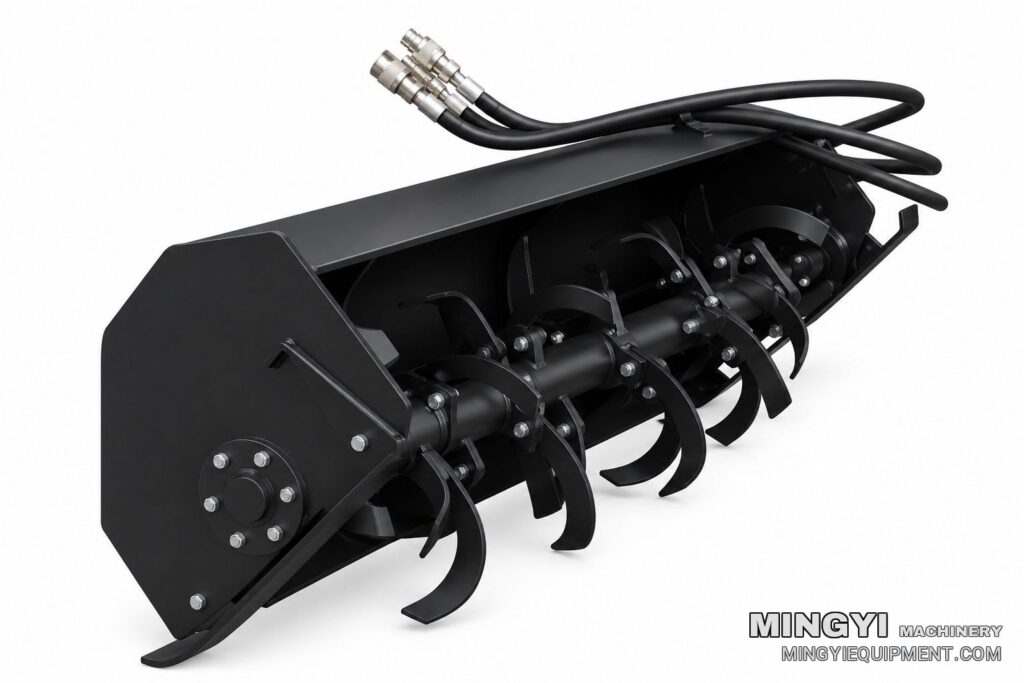
A rotary tiller is a hooded rotor of curved blades, driven by a hydraulic motor through a chain or a gearbox and hung on the quick-attach plate of a skid steer loader, compact track loader, wheel loader or hydrostatic wheel loader. It breaks the surface, mixes what is in the soil and leaves a level crumb in one pass, which is why it replaces a plough, a rotavator and a rake on the same patch of ground. Beds, seedbeds, lawns, orchard alleys and overgrown corners all come out workable in a fraction of the time a walk-behind tiller takes.
How the rotor works
The rotor turns into the direction of travel, so each blade slices a slice of soil, lifts it and throws it against the hood. The impact breaks the clods, and the mixture falls back behind the rotor, where a rear gate or a roller crumbles it again and leaves the surface level. Depth is set by the side skids and by the height of the rear roller relative to the blades, not by a hydraulic circuit, so the tiller works on the loader’s float position and the operator’s control is the rate of travel: slow for a fine seedbed, faster for a first pass on rough ground. Two passes at right angles give a seedbed that rakes out flat; one pass in the same direction leaves ridges between the blade tracks.
Depth, blades and the ground
Depth is mechanical, so the machine’s attitude matters more than any gauge: keep the plate level, run the arm in float, and do not let the loader dip as the front wheels or tracks drop into a hollow, or the tiller will cut a wave. Blades are either C-shaped for general work or L-shaped for heavier trash, and they are bolted on so a worn or broken one can be changed at the row end. A slip clutch or a shear bolt protects the drive train when a stone or a root stops the rotor. Wet soil smears and compacts under the blades, so wait for it to dry rather than work it wet; heavy stone or rubble is a job for a stone burier or a breaker, not a tiller. On established weeds, two shallow passes a fortnight apart do more than one deep pass, because the first pass brings roots to the surface to dry.
Fitting it to the carrier
The tiller mounts on the standard quick-attach plate shared by skid steer loaders, compact track loaders and wheel loaders, so it hangs on the same frame as the bucket; the hydrostatic wheel loaders MY130S, MY180S and MY180TS take the same plate in the matching size. The rotor is hydraulically driven and takes real power at depth, so width and blade count have to follow the oil available: a wide tiller on a low-flow machine turns slowly, leaves clods and bogs the drive, while a narrow one on a high-flow machine works well but covers less ground. It needs the carrier’s auxiliary hydraulic flow to match — confirm against your machine’s configuration, and send the model so rotor speed, motor and hose set are specified together. Check the lift capacity too, because a tiller carries its weight well forward.
Choosing the width and the fittings
Width is chosen against the carrier and the job, not the other way round: a machine that will run a wide tiller in loam may only pull a narrow one in clay. A side-shift frame lets the rotor work along a wall, a fence or a kerb without the machine tracking in the bed. Skids set the depth, a roller or a rear gate sets the finish, and a bolt-on level board or a seeder box can be added at build if the job is turf or a cover crop. Blades, blade bolts and the drive chain are the wear parts, and a spare set of blades is worth shipping with the first unit. Rotor width, weight and blade count are confirmed against your machine before pricing.
Ordering and shipping
Minimum order one unit, lead time 25–35 days, CE certification and a 12-month warranty. The tiller ships with the quick-attach plate fitted, the rotor and blades assembled, the chain tensioned and hoses with flat-face couplers to suit the carrier. Spare blades, bolts and a chain link can travel in the same container. Photos of the finished unit and a video of it working in real ground go out before the container is sealed.
Where a rotary tiller is used
Twenty-one jobs, from the ones it is bought for to the occasional ones. Each is ground that has to be broken, mixed and left level in one pass, with the depth set by the skids and the machine, not by a gauge on a wall.
- Vegetable and market beds — Break and level a bed for direct sowing or transplanting, in a garden or a field scale strip.
- Polytunnel and greenhouse prep — Till the soil inside a tunnel where a tractor cannot turn, working along the beds.
- New lawn and turf prep — Work a seedbed down to a fine tilth before turf or seed, in two crossing passes.
- Lawn renovation — Strip dead thatch, break the surface and mix in topsoil before re-seeding a worn lawn.
- Sports turf and pitches — Renovate a training pitch or a school field, working the surface back to a level seedbed.
- Garden landscaping — Turn rough ground into planting beds around a new house, mixing topsoil into the subsoil.
- Flower borders and shrub beds — Prepare beds for shrubs and perennials where a spade and a fork would take days.
- Orchard alley management — Keep the strip between tree rows worked and weed-free without damaging the trees.
- Vineyard row preparation — Work the soil along the rows before planting, or between rows in a young vineyard.
- Soft fruit and berry rows — Prepare and maintain the strip under berry rows where a mower cannot reach.
- Allotment and smallholding — Bring overgrown allotment plots back into production in a morning rather than a season.
- Paddock reseeding — Break and level poached ground before grass seed, around gateways and along fence lines.
- Food plots and game strips — Prepare a small wildlife plot in a field corner where a tractor cannot easily reach.
- Compost and manure mixing — Mix compost, farmyard manure or green waste into the top layer before planting.
- Lime and fertiliser incorporation — Work lime or fertiliser into the surface so it is not left lying on top.
- Green manure incorporation — Chop and bury a cover crop into the topsoil before the next crop goes in.
- Reclaiming overgrown ground — Cut through bramble, bracken and rough grass on ground that has been out of use.
- Sand into clay — Mix sand or grit into a heavy clay garden soil to open it up for planting.
- Tree and hedge planting beds — Prepare a wide bed or a hedge line before planting whips and standards.
- Stable and yard weed strips — Clean up the strip along stable walls, muck heaps and fence lines.
- Verge and track edges — Re-work a worn verge or the edge of a farm track before seeding it back down.
A tiller is bought for ground that has to be re-made, not just cut. Tell us the soil, the depth you want to work and the carrier, and we match width, blade count and rotor speed once. Stony ground is the one case where we will tell you to use something else.
Ask about this machine
Product for this enquiry: Rotary Tiller — Quick Attach for Skid Steer, Track, Wheel & Hydrostatic Loaders