Chain Trencher — Quick Attach for Skid Steer, Track, Wheel & Hydrostatic Loaders
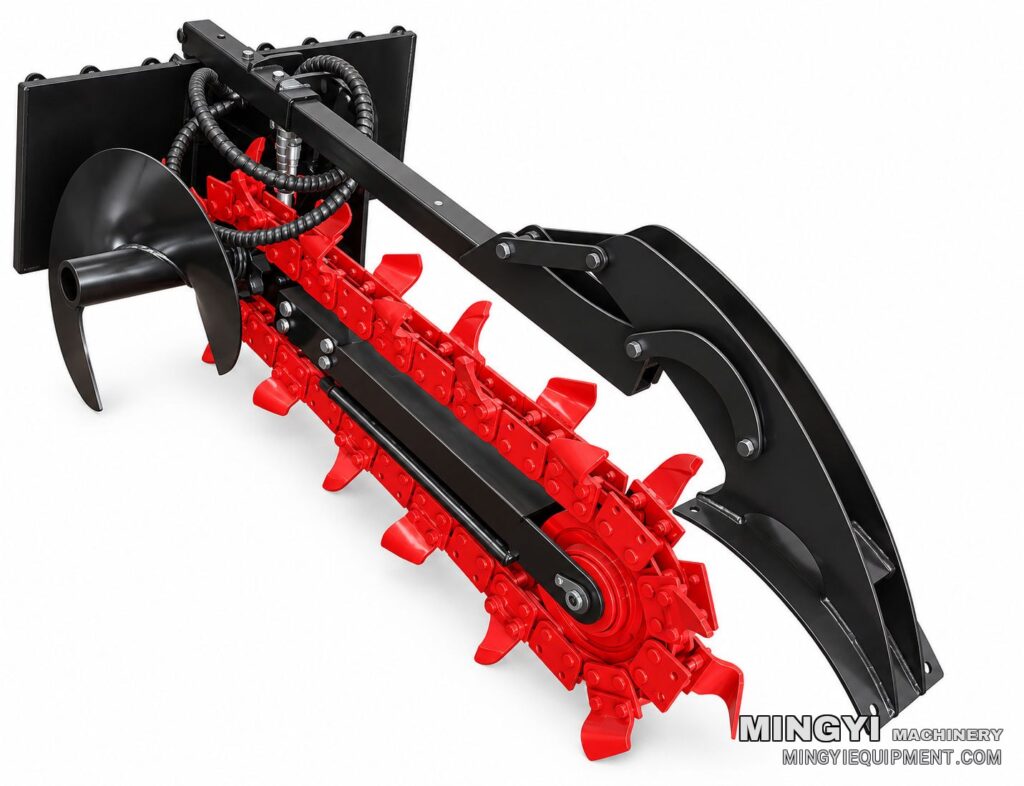
A chain trencher is a narrow boom carrying an endless chain of cutting teeth, hung on the quick-attach plate of a skid steer loader, compact track loader, wheel loader or hydrostatic wheel loader. It cuts a straight trench at a set depth and throws the spoil to one side, so one operator in one machine opens a service run instead of hiring a mini excavator and a man with a shovel. The walls come out parallel top to bottom, which is what a pipe or a duct actually needs, and the cut is fast enough that a day of cabling becomes a morning.
How the chain cuts a trench
The chain runs round a boom that is lowered into the ground. The teeth score the sides and the bottom, and the chain flights carry the spoil up and out. A crumber or clean-out shoe follows the teeth and scrapes the bottom flat, so a pipe bed does not need hand trimming afterwards. Depth is set by the skid shoe, or by the boom angle and the machine float position where there is no shoe, and the operator controls the rate of travel: too fast in clay and the chain polishes the walls instead of cutting, too slow in sand and the spoil runs back in. Spoil lands on one side only, so the machine works with the spoil side turned away from the wall, the fence or the road.
Chain, width and depth for the job
Trench width is set by the chain and its side plates, depth by the boom length, so the same head can be supplied for a narrow cable run or a wider drainage run. Service trenches are typically narrow enough for a duct plus a bedding layer; land drains and footing runs need more room for pipe, gravel or concrete. Teeth follow the ground: earth teeth for loam and sand, carbide or rock teeth for chalk, limestone and broken rock, and a mixed chain with a few rock teeth for stony soil. Heavy clay smears and packs the chain, loose sand lets the walls run in, and cobbles or builders rubble make the chain jump and break teeth. Frozen ground and old concrete want a breaker first. Tell us the ground and the pipe and the chain, teeth and crumber are matched to the job rather than to a catalogue number.
Fitting it to the carrier
The head mounts on the standard quick-attach plate shared by skid steer loaders, compact track loaders and wheel loaders, so it goes on the same frame as the bucket. The hydrostatic wheel loaders MY130S, MY180S and MY180TS take the same plate in the matching size and run the head as delivered. Because the chain is hydraulically driven, the carrier’s auxiliary hydraulic flow has to suit the head: a wide, deep chain on a low-flow machine turns slowly and clears spoil badly, while a high-flow circuit on a narrow chain only heats the oil. It needs the carrier’s auxiliary hydraulic flow to match — confirm against your machine’s configuration, and send the model so motor displacement, chain speed and hose length are specified together.
Backfill and reinstatement
The trench is only half the job. Spoil sits in a windrow along one edge, so backfilling with the loader bucket is a single pass, and the same machine can water it in and track it down. On a gravel drive or a lawn, lift the turf in spits before the chain goes in and lay it back afterwards; on a land drain, gravel or a filter sock goes round the pipe before the spoil returns. A backfilled line settles for a season, so leave the surface slightly proud rather than flush, and check it again after the first wet winter.
Ordering and shipping
Minimum order one unit, lead time 25–35 days, CE certification and a 12-month warranty. The head ships with the quick-attach plate fitted, the chain and teeth on the boom, and hoses with flat-face couplers to suit the carrier. Spare teeth and a spare chain link set can travel in the same container. Photos of the finished unit and a video of it cutting in real ground go out before the container is sealed.
Where a chain trencher is used
Twenty-one runs, from the ones it is bought for to the occasional ones. Each is a length of trench rather than a single hole, and each is faster with a chain than with a bucket, a spade or a hired mini excavator.
- House water supply — Trench from the boundary stopcock to the house through garden and under a path, deep enough to stay below frost.
- Power to outbuildings — Armoured cable to a shed, garage or stable, in a narrow trench that a spade would take a day to open.
- Irrigation mainlines — The main run for a sports field or market garden sprinkler system, with a clean flat bottom for the pipe.
- Field drainage laterals — Cut laterals across a wet paddock to a collector, laying pipe and gravel as the trench closes.
- Gas and LPG services — A buried gas line to a house or workshop where the supplier wants a straight, even bed.
- Fibre and telecom ducts — A narrow duct run along a lane or verge, straight and at even depth, with the spoil kept off the path.
- Trough water lines — Water pipe across grazing to troughs, set deep enough to survive stock and hard frost.
- Garden lighting cable — Cable to bollards and uplighters across a landscaped garden without lifting the whole lawn.
- Surface water connections — Gutter downpipes and yard gullies connected to a soakaway or ditch across a lawn.
- Kerb and edge restraint — A straight chase for block edging or steel edging along a drive or a car park.
- Strip footings in soil — A footing trench for a garden wall or shed base in ground a bucket would only crumble.
- Gate and intercom cable — Power and signal to an entrance gate, barrier or intercom at the end of a long drive.
- Vineyard and orchard drip lines — Drip pipe down the rows, trenching between posts without cutting vine roots.
- Ground source heat loops — Horizontal collector trenches for a heat pump, several runs at matched depth and spacing.
- Sports pitch sprinklers — Pop-up irrigation lines across a pitch, cut straight so the heads line up.
- Yard drainage channels — A trench for a linear channel or slot drain along the edge of a concrete apron.
- Solar array cabling — String cable trenches between rows on a ground-mounted solar array.
- Temporary site services — Water and power to site cabins, welfare units and a tap point on a building site.
- Low corner drainage — A drain from a wet corner of a yard or paddock out to a ditch or a sump.
- EV charge point supply — Cable from the house to a charge point on the far side of a parking area.
- Culvert outfall runs — The outfall from a land drain or a ditch to a watercourse, cut to a steady fall.
A trencher is bought for the run, not the hole. Order the head with the width and depth that match the pipe, and the chain that matches the ground — a rock chain in loam is slow, an earth chain in chalk is expensive. Send the carrier model and the job and the head is specified once, not twice.
Ask about this machine
Product for this enquiry: Chain Trencher — Quick Attach for Skid Steer, Track, Wheel & Hydrostatic Loaders