Flail Mower for Skid Steer Loader, Compact Track Loader and Hydrostatic Wheel Loader
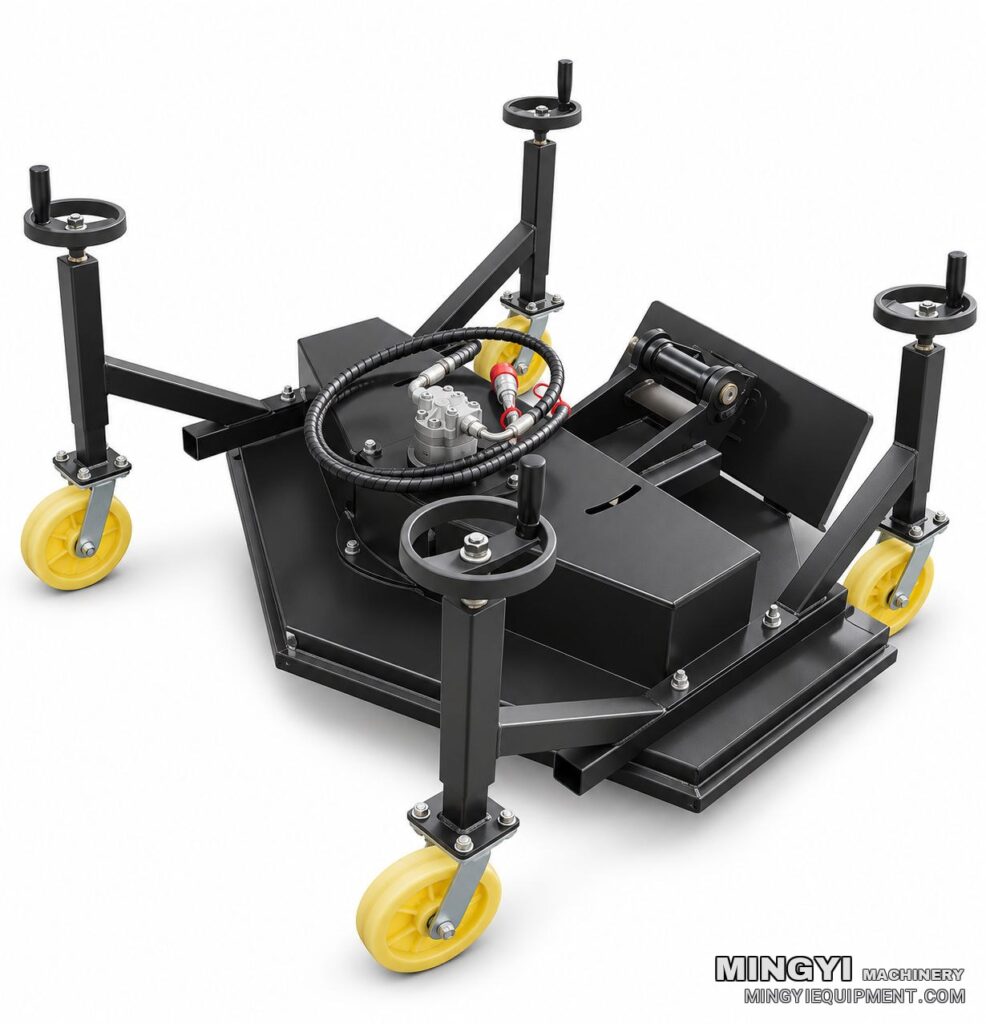
A flail mower is a horizontal rotor inside a steel hood, carrying free-swinging flails that beat the growth against a fixed counter-blade instead of shearing it between two scissor blades. It hangs on the quick-attach plate of a skid steer loader, compact track loader, wheel loader or hydrostatic wheel loader, and it cuts what a finishing deck will not touch: rank grass, nettles, brambles, reeds, light scrub and roadside vegetation with stone and wire lying in it. One pass leaves the material as mulch in the swath, not in rows to be cleared up.
How it works
The flails are hinged, not fixed. When one meets a stone, a length of wire or a lump of hard wood it folds back into the hood and swings out again, so the rotor keeps its speed and the shock goes into the hinge pin rather than the gearbox. Cutting is by impact against the counter-blade, which is why a flail takes stemmy, wet or matted growth that a rotary mower rides over or leaves standing. The material is held inside the hood and discharged downwards behind the rear roller instead of being fired out of a side chute: beside a carriageway, a fence line or a building, that is the difference between mowing and sweeping up afterwards. Cut height is set by the rear roller and the skid shoes, so the head follows the ground rather than the loader’s linkage.
Where it works
Verges, ditches, embankments, orchard alleys, vineyard rows, pasture and amenity grass — anywhere the growth is too coarse for a deck and too close to something that must not be hit. The list below runs from the jobs these heads are bought for to the occasional ones.
Compatibility with your loader
The mower mounts on the standard quick-attach plate shared by skid steer loaders, compact track loaders and wheel loaders, so it changes over the same way a bucket does. The MY130S, MY180S and MY180TS hydrostatic loaders take it on the same specification of plate. What has to be checked is the auxiliary hydraulic flow: the head is driven by a hydraulic motor and needs the carrier’s auxiliary flow to match — confirm against your machine’s configuration before the head width is fixed. A head that is too wide for the flow bogs down in heavy grass; on a lower-flow machine the answer is a narrower head, not a larger motor.
Typical specification
Head width is chosen against the carrier’s outside width and the job. A head that covers the wheel tracks suits verges and open ground; a narrower head with side shift reaches into ditches and under fences without the machine leaving the track. Offset is a common configuration — the head slides hydraulically to one side and works beyond the wheels — but the amount of travel is typical and varies by carrier. Flail type matters as well: Y-flails for grass and light scrub, heavier hammer flails for woody growth and stony ground. Width, weight, flail type and flow class are quoted against your machine; we do not publish one maximum that would be wrong for half the loaders in the field.
Ordering and shipping
Minimum order one unit, lead time 25–35 days, CE certification and a 12-month warranty. The head ships with hoses and flat-face couplers matched to the carrier, and a spare set of flails can travel in the same container. Photos of the finished unit and a video of it cutting go out before the container is sealed.
Where a flail mower is used
Twenty-two jobs, from the ones a flail head is bought for to the occasional ones. In every case the point is the same: take coarse growth down to an even height, keep the cuttings in the swath, and keep the machine off ground it should not be on.
- Roadside verge mowing — Council and contractor verges, with the head offset past the wheel track so grass is cut to the fence without driving on it.
- Ditch and bank mowing — Steep channel banks and drain sides, where the flails ride over stone and the hood keeps cuttings out of the water.
- Field margin topping — Nettles, thistles and rough grass on field edges and set-aside, cut before they seed into the crop.
- Pasture topping — Rank grass, rushes and docks left after grazing, knocked down and spread as mulch instead of lying in lumps.
- Orchard alley mowing — Between tree rows and under low branches, where a deck would scalp and a flail follows the ground.
- Vineyard mid-row mowing — The strip under the vines, with the head offset to keep the rotor clear of posts and fruit.
- Bramble and scrub control — Tracks, banks and ground being brought back into use, where the growth is woody and lying down.
- Reed and rush cutting — Wet ground, canal banks and drainage channels, cut in conditions that stop a rotary deck.
- Motorway and trunk road embankments — Long, wide verges and slopes taken in one pass per side, with the cuttings held in the hood.
- Railway lineside vegetation — Embankments and cess beside the track, where thrown debris is not acceptable.
- Canal towpath and flood bank — Towpath edges and flood defences kept short for inspection and access.
- Reservoir dam and levee mowing — Grass on dams and levees kept low so inspections and seepage checks stay possible.
- Solar farm and substation grass — Between panel rows and around cabinets, where stone and cable lie in the grass.
- Fence line and hedge bottom — Under stock fence and along hedge bottoms, with the offset head reaching past the posts.
- Paddock and arena margins — Rough corners, gateways and ménage edges that a small deck cannot reach or will not cut.
- Airfield and runway margins — Grass margins kept low and cuttings held down, away from the movement area.
- Parks and amenity rough grass — Long grass on the edges of parks, playing fields and open space, cut without strimming.
- Golf course rough and woodland edge — Rough, bracken and saplings at the tree line, mown back to a playable width.
- Bracken and moorland management — Hill ground and moor edges, where the growth is rank and the ground is uneven.
- Firebreak and track clearing — Overgrown access tracks and firebreaks reopened before the season.
- Plot clearance before survey — Bramble and scrub on a development plot taken down so the ground can be walked and set out.
- Rental and contracting fleets — One head keeps every verge, bank and orchard row on a hire fleet or contracting round in shape.
The mower shares the quick-attach plate with the bucket, so the loader that mows the verge still loads the cuttings. Send the carrier model and the ground you are cutting, and we confirm head width, flail type and flow class before pricing — a head built for a full-size wheel loader will not clean up behind a compact track loader.
Ask about this machine
Product for this enquiry: Flail Mower for Skid Steer Loader, Compact Track Loader and Hydrostatic Wheel Loader