
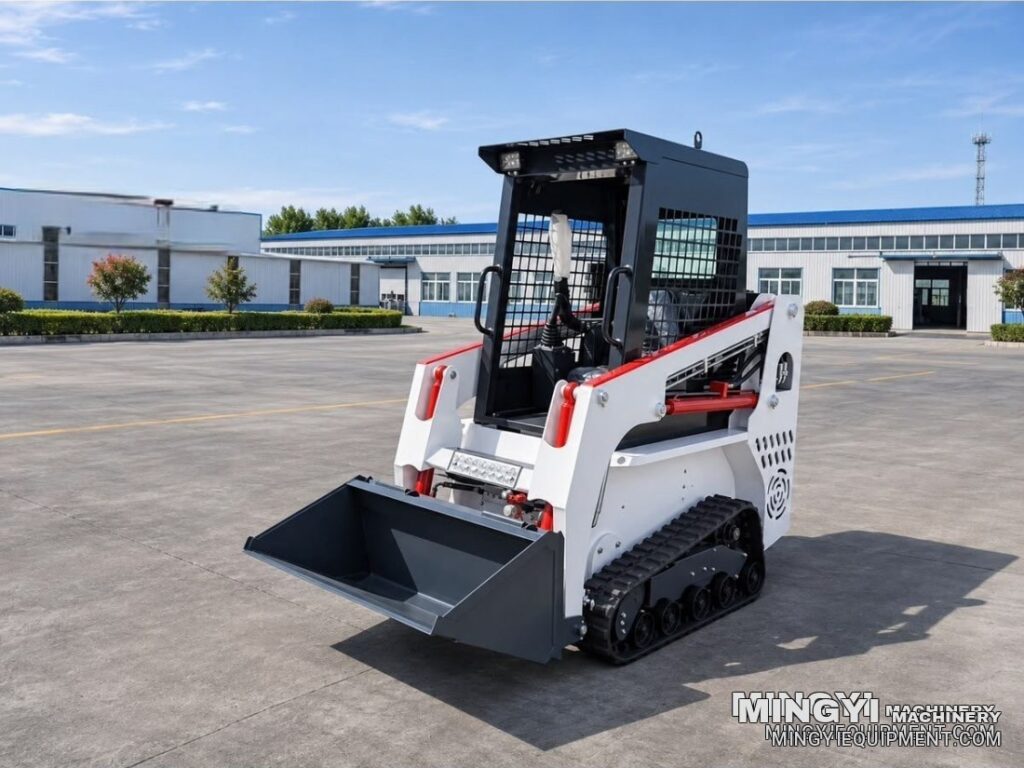
MY25 Crawler Skid Steer Loader (Compact Track Loader)
Tracked skid steer loader with a load-sensing piston pump and standard quick-attach coupler, sized for tight yards, covered work and soft ground. CE certified, MOQ 1 unit, 25-35 days from our Qingdao plant.
Performance
| Engine | Runtong R999 (standard) |
|---|
Chassis & driveline
| Drive | Four wheel-motor travel drive |
|---|
Other
| Hydraulic system | Open-circuit piston pump, load-sensing |
|---|---|
| Control | Pilot joystick operation |
| Quick coupler | Standard quick-attach coupler |
A skid steer has no steering axle and no wheels that turn. Direction is changed by driving the two sides of the machine at different speeds, or in opposite directions, and letting the tracks scrub sideways on the ground. On a crawler machine the same principle applies to the tracks: slow the left side and the machine turns left, reverse one side and it spins about its centre. Because the machine pivots within its own footprint, it can work in a yard where a conventional loader would need three attempts to turn. The trade-off is that skid steering always costs something in surface wear, and an operator learns quickly that a planned, gentle turn is cheaper than a sharp correction. That is also why the undercarriage, rather than the engine, usually sets the service life of a machine in this class.
The value of this layout appears in places with no room to manoeuvre: a farmyard between a shed and a wall, a garden gate the machine barely passes through, a building site where the material stack sits close to the excavation. A crawler skid steer can enter, turn within its own length and leave without reversing the way it came, which is often the difference between a job done with one machine and one that needs a second pair of hands to guide it. The operator also works closer to the trench edge, because the machine can be placed precisely rather than approximately. That precision, more than travel speed or capacity, is what buyers in this class are actually paying for. It also cuts the labour needed around the machine, which matters on a small site with a tight budget.
What this machine is called in the trade
Skid-steer loaders carry more names than any other machine in this catalogue. The MY25 is a skid steer loader in the specification, a skid loader on most North American sites, a compact track loader when it runs on tracks rather than tyres, and a tracked skid steer when the buyer wants the crawler undercarriage stated plainly.
For this build the rated load and operating weight are confirmed with the quotation, because the undercarriage option moves both figures. What does not change is the footprint: a skid steer loader that turns inside its own length, works under a 2.4 m clearance and takes attachments on a standard quick attach plate.
Full specification
Configuration, attachments and the complete datasheet are confirmed at quotation stage for your market.
What this layout is actually for
The MY25 is a crawler skid steer: no steering axle, no steer wheels, direction changed by driving the two track sides at different speeds. That single fact explains the rest of the machine. It turns inside its own footprint, so it works in a yard where a conventional loader needs three attempts to line up. It also means every turn scrubs the surface, which is why the undercarriage rather than the engine usually sets the service life of a machine in this class.
Where it earns its keep, and where it does not
The layout pays off where there is no room to manoeuvre: between a shed and a wall, through a garden gate the machine barely passes, on a site where the material stack sits against the excavation. It gives up travel speed and ride quality on the road, and it is not the machine to send along a finished driveway. Buyers who compare it with a compact wheel loader are usually choosing between working in tight space and moving quickly between jobs; it will not do both.
Why the undercarriage sets the service life
On a skid steer the tracks or tyres take the punishment that a steering axle would take on a conventional machine. Every turn scrubs the surface, and on abrasive ground that is the wear that ends the machine’s working life long before the engine is tired. Budget for tracks as a consumable, not a repair, and the ownership cost becomes predictable.
Attachments, and why the coupler matters more than the engine
This machine runs the standard quick coupler, so the bucket, forks, grapple and sweeper all mount from the seat in a couple of minutes. In practice the attachment set decides what the machine can earn: the same chassis with a 4-in-1 bucket, pallet forks and a trencher covers work that would otherwise need three machines. Ask for the attachment list with your quote rather than buying the machine first and looking for implements afterwards.
Delivery, spares and documents
Every unit is CE certified and ships from Qingdao in 20–30 days, one unit minimum. Track rubber, the bucket edge and the filter set are the consumables that actually wear on this class, and they are common across the range. Send the working width and the surface you operate on and we will confirm the track specification before the order is fixed.
Service intervals and what they cost you
| Item | Interval |
|---|---|
| Engine oil and filter | 100 h or monthly |
| Track tension | weekly |
| Hydraulic oil filter | 500 h |
| Attachment coupler pins | grease every 50 h |
Intervals recommended for normal duty. The manual supplied with the machine governs, and dust, heat or continuous shift work shorten every one of them.
What documents travel with the machine?
The commercial invoice, the packing list, the bill of lading and the CE declaration of conformity travel with every shipment, and the operator manual goes with the machine rather than by post afterwards. If your customs broker needs a certificate of origin or a fumigation certificate, say so before the container is sealed.
Can the machine be built to my specification?
Colour, decals, bucket width, the attachment coupler and the operator station are specified at order. The undercarriage, the engine and the working envelope are not, because those define the model: asking for a different one means a different model rather than an option.
Other tracked skid steers in this range
The range also includes the MY320 tracked skid steer, MY360 tracked skid steer and MY1000 tracked skid steer. All of them are compact track loaders running the same attachment coupler.
Fitting and changeover
Will it damage a finished lawn?
A tracked machine spreads its weight over a much larger footprint than a wheeled skid steer, so it works on finished ground where wheels would rut. It is not damage-free: a sharp turn still scuffs. The practical answer is to plan turns wide, and to keep the machine off resin-bound or block paving.
What attachments fit the standard coupler?
Bucket, 4-in-1 bucket, pallet forks, grapple, sweeper and trencher all mount from the seat. In practice the attachment set decides what the machine earns: the same chassis with three implements replaces three machines, which is usually the argument that wins the purchase.
Can one trailer carry it?
These machines are sized for a plant trailer behind a suitably rated vehicle rather than a low-loader. Check the gross train weight and the trailer rating before you plan the move: the transport cost recurs on every job, the purchase price is paid once.
Custom builds, OEM and private label
Nothing on the MY25 is locked at the factory gate. Each unit is built to order, which means the working parts, the paint and the plate are all settled at the point of order.
On a skid-steer that usually means the attachment interface, tyre type, canopy or sealed cab with heater, auxiliary hydraulic flow, paint colour, decal set, and the language on the plate and in the manual.
- Attachments: standard skid-steer quick attach, or pin-on
- Tyres: pneumatic, solid, or over-tyre tracks
- Cab: canopy or sealed cab with heater
- Branding: your nameplate, your decals, your manual
We also build under our customers’ own brands. Private label means your nameplate, your decals, your manual and your packaging, with the machine otherwise identical to the catalogue build; the MINGYI plate stays available if you would rather sell it as ours. Drawings and first-article photographs are approved before production starts, and a batch order is held to one specification so the second container matches the first. One unit is enough to begin. Send us the working condition and the brand you sell under and we will quote the build.
Ask about this machine
Related models
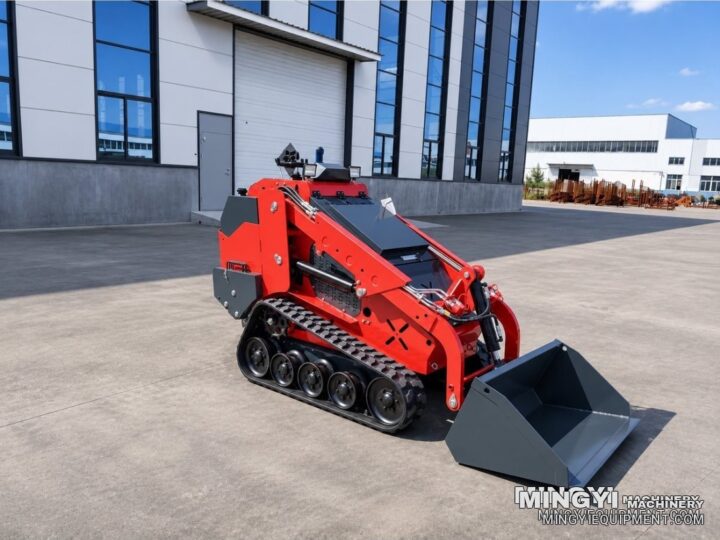
MY1000 Tracked Skid Steer Loader, 300 kg Rated Load (Compact Track Loader)
- Power 18.4 kW (25 hp)
- Rated engine speed 3,600 rpm
- Emission standard EU Stage V / EPA Tier 4 Final
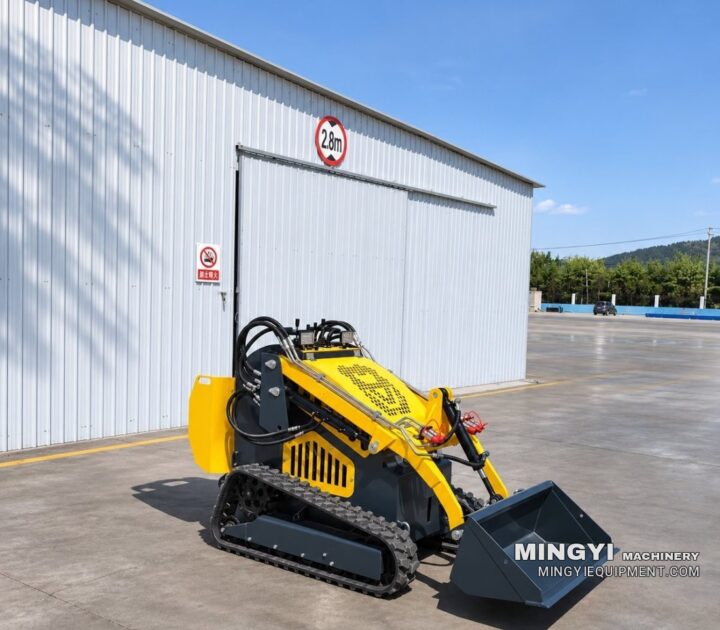
MY360 Crawler Skid Steer Loader (Compact Track Loader)
- Hydraulic system Twin-pump, three-valve
- Engine Runtong R740 (standard)
- Configurations Stand-on crawler / stand-on wheeled
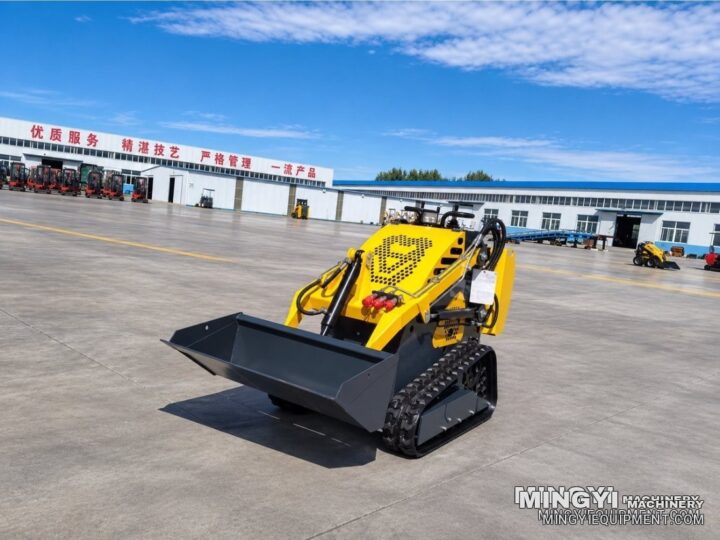
MY320 Crawler Skid Steer Loader, 200 kg Rated Load (Compact Track Loader)
- Rated load 200 kg
- Max load 300 kg
- Operating weight 630 kg